How Restriction Can Actually Make Binge Eating Worse
After binge eating, restriction can feel like the obvious solution.
You may think:
“I ate too much last night, so I’ll skip breakfast.”
“I’ll be really healthy today.”
“No carbs this week.”
“I need to make up for what I ate.”
These thoughts are understandable. But for many people, attempts to compensate for binge eating can unintentionally increase the likelihood of another binge.
Restriction Isn’t Always Obvious
When we hear “restriction,” we may imagine someone barely eating.
But restriction can be much more subtle.
It can include skipping meals, delaying eating, cutting out certain foods, intentionally eating less after a binge, ignoring hunger, or creating rigid rules about when and what you’re allowed to eat.
There can also be mental restriction.
For example, you eat dessert but spend the entire time thinking you shouldn’t.
Or you technically allow yourself pizza but decide you’ll compensate tomorrow.
Your body received food, but psychologically the food still feels forbidden.
Restriction Can Increase Food Preoccupation
Have you ever decided you’re absolutely not going to eat something—and then found yourself thinking about it constantly?
That’s not unusual.
When food is scarce or forbidden, it becomes more important.
Physical restriction can increase hunger.
Psychological restriction can increase preoccupation.
Combine intense hunger with a food you’ve told yourself you aren’t allowed to have, and the experience can become particularly powerful.
The “I Blew It” Moment
Rigid rules also create opportunities to fail.
If your rule is:
“No sweets.”
Then eating one piece of candy means you’ve broken the rule.
If your thinking is all-or-nothing, the next thought may be:
“Well, today is ruined anyway.”
That can lead to eating much more than you otherwise would have—not because you needed all of that food, but because tomorrow’s restriction is already looming.
“I better eat it now because tomorrow I can’t.”
This is sometimes called the last supper mentality.
When your brain believes access to a food is about to disappear, urgency can increase.
Regular Eating Can Feel Scary at First
For someone who experiences binge eating, the idea of eating more consistently can initially sound backward.
You might worry that if you stop restricting, you’ll never stop eating.
But consistent nourishment can help reduce the intense biological hunger that often contributes to feeling out of control around food.
It can also create opportunities to learn:
Am I hungry?
Am I satisfied?
Do I actually enjoy this food?
What amount feels comfortable?
Those questions are difficult to answer when you’re ravenously hungry or convinced this is your last opportunity to eat a particular food.
The Goal Isn’t “No Rules Ever”
Recovery from binge eating isn’t about throwing structure away and hoping for the best.
Structure can be helpful.
The difference is between supportive structure and rigid control.
Supportive structure might mean making sure you have time for lunch during a busy workday.
Rigid control might mean deciding lunch can’t exceed an arbitrary amount regardless of how hungry you are.
One helps you care for yourself.
The other can disconnect you from your body’s needs.
Learn How to Step Out of the Cycle
Understanding restriction and the binge-restrict cycle will be an important part of our upcoming Dallas Nutritional Counseling’s upcoming 6-week Virtual Binge Eating Support Group provides a place to learn about these patterns while receiving support from others who understand.
Led by Paige McDaniel, MS, RD, LD, CEDS, the group combines education and practical tools with open discussion and group support.
October 12 – November 16 | Mondays at 6 PM | Virtual
$500 for all 6 sessions, $450 with early bird registration (use code EARLYBIRD at check out before October 25th). Cost can be split into two separate payments.
The group is limited to 8 participants to allow for meaningful conversation and connection.
Contact Dallas Nutritional Counseling to learn more.
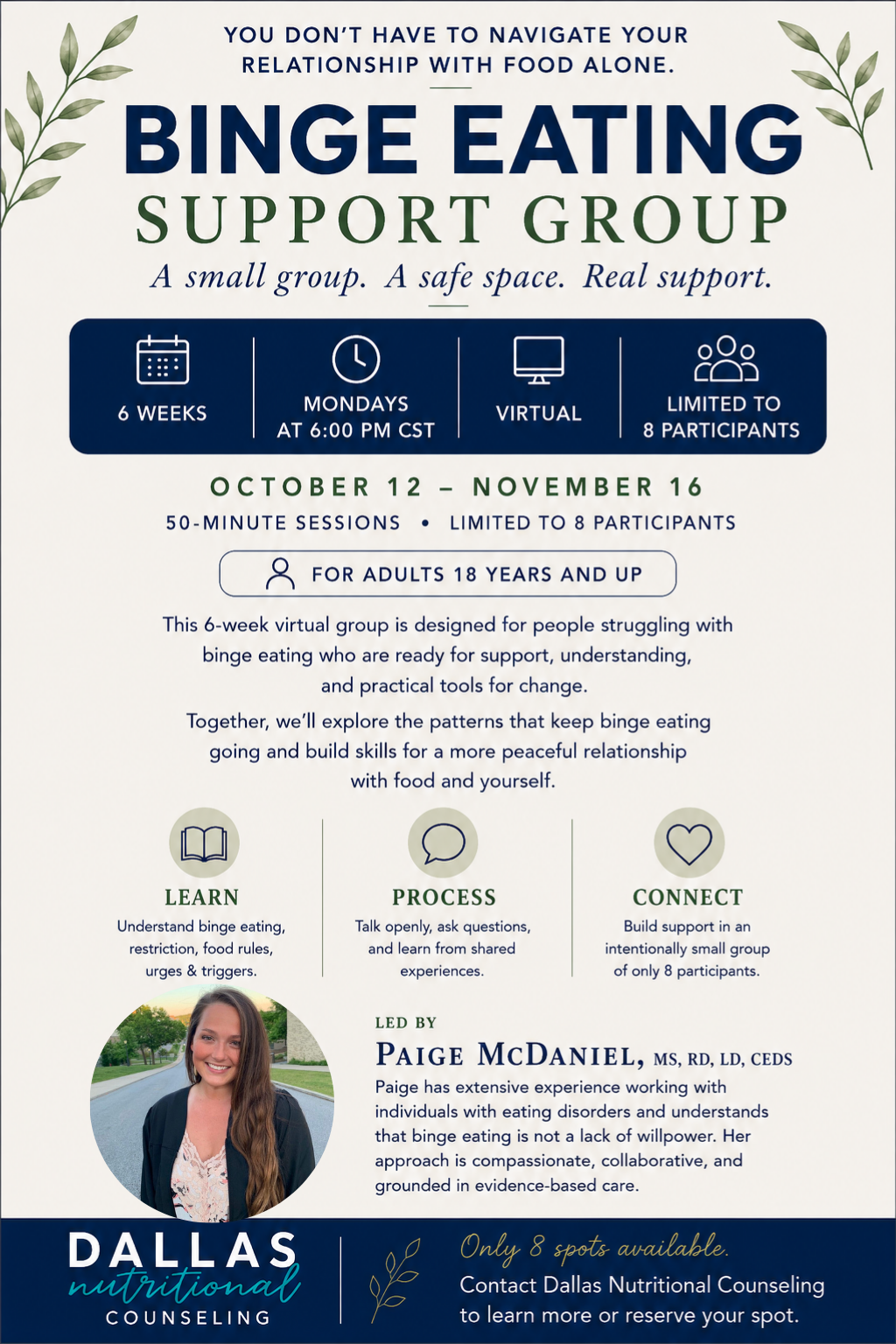
Binge Eating Support Group - Beginning October 12th, Dallas Nutritional Counseling, Paige McDaniel
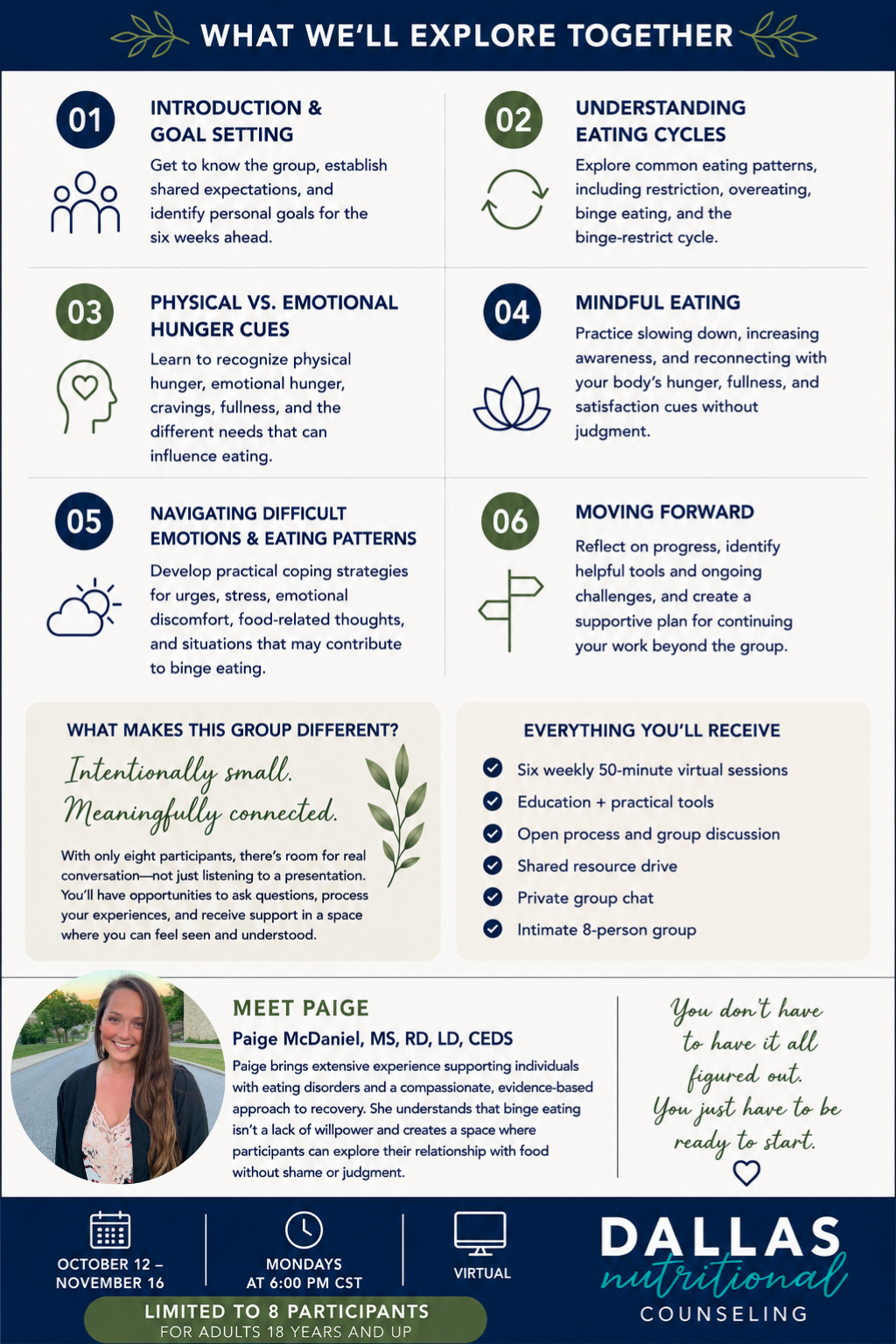
Binge Eating Support Group - Beginning October 12th, Dallas Nutritional Counseling, Paige McDaniel

Why Willpower Isn’t the Answer to Binge Eating. 6-Week Virtual Group | Monday Evenings | 6:00 PM CST, October 12 – November 16, 50-minute sessions | Limited to 8 participants