Why Willpower Isn’t the Answer to Binge Eating
After a binge, it’s common to think:
I need more discipline.
I need to stop buying that food.
I need to try harder.
Why can’t I control myself?
Binge eating can feel like a failure of willpower.
But treating it that way can keep you focused on fighting the behavior rather than understanding what’s contributing to it.
Binge Eating Doesn’t Happen in a Vacuum
Eating behavior is influenced by many things.
Physical hunger.
Restriction.
Food availability.
Stress.
Sleep.
Emotions.
Habits.
Environment.
Food rules.
Body image.
When we reduce binge eating to “self-control,” we ignore the factors that may be making the urge to binge much stronger in the first place.
Imagine Holding Your Breath
You can consciously hold your breath for a while.
Eventually, however, your body’s drive for oxygen becomes much more powerful than your desire to keep holding it.
Food restriction isn’t identical, of course, but the analogy illustrates something important:
Biological drives become difficult to override indefinitely.
If you’ve eaten very little all day and are intensely hungry by evening, needing more “willpower” around food may not be the real issue.
Your body may simply need nourishment.
The Forbidden Food Effect
Now add rigid food rules.
Imagine you’ve decided you’re never going to eat cookies.
Suddenly, cookies carry much more meaning.
You think about them when they’re in the break room.
You negotiate with yourself when you see them at the grocery store.
You tell yourself you absolutely cannot have one.
Then one evening, you eat a cookie.
Your response might be:
“I blew it.”
That thought can turn one cookie into an all-or-nothing experience.
“I’ll start again tomorrow, so I might as well eat them now.”
The issue wasn’t necessarily that cookies are uniquely powerful.
The rules surrounding them may have helped create the sense of urgency.
Shame Rarely Creates the Change We Want
After a binge, many people respond with harsh self-criticism.
But shame often leads directly back to the behaviors that maintain the cycle.
You binge.
You feel ashamed.
You decide to compensate.
You restrict.
Hunger and food preoccupation increase.
You binge again.
Instead of asking, “What’s wrong with me?”, try asking:
“What happened before this?”
Had you eaten enough?
Were you following strict food rules?
Were you exhausted?
Were you experiencing a difficult emotion?
Did you feel deprived?
What were you telling yourself about the food?
Curiosity gives you information.
Shame usually doesn’t.
What Helps Instead?
Reducing binge eating may involve working on several things at once:
Establishing more consistent eating.
Reducing unnecessary restriction.
Challenging all-or-nothing food rules.
Learning to recognize hunger and fullness.
Increasing access to satisfying foods.
Understanding emotional triggers.
Developing additional coping strategies.
Practicing self-compassion after difficult eating experiences.
None of those require perfect eating.
They require practice.
You Don’t Have to Figure It Out Alone
Dallas Nutritional Counseling’s upcoming 6-week Virtual Binge Eating Support Group provides a place to learn about these patterns while receiving support from others who understand.
Led by Paige McDaniel, MS, RD, LD, CEDS, the group combines education and practical tools with open discussion and group support.
October 12 – November 16 | Mondays at 6 PM | Virtual
$500 for all 6 sessions, $450 with early bird registration (use code EARLYBIRD at check out before October 25th)
The group is limited to 8 participants to allow for meaningful conversation and connection.
Contact Dallas Nutritional Counseling to learn more.
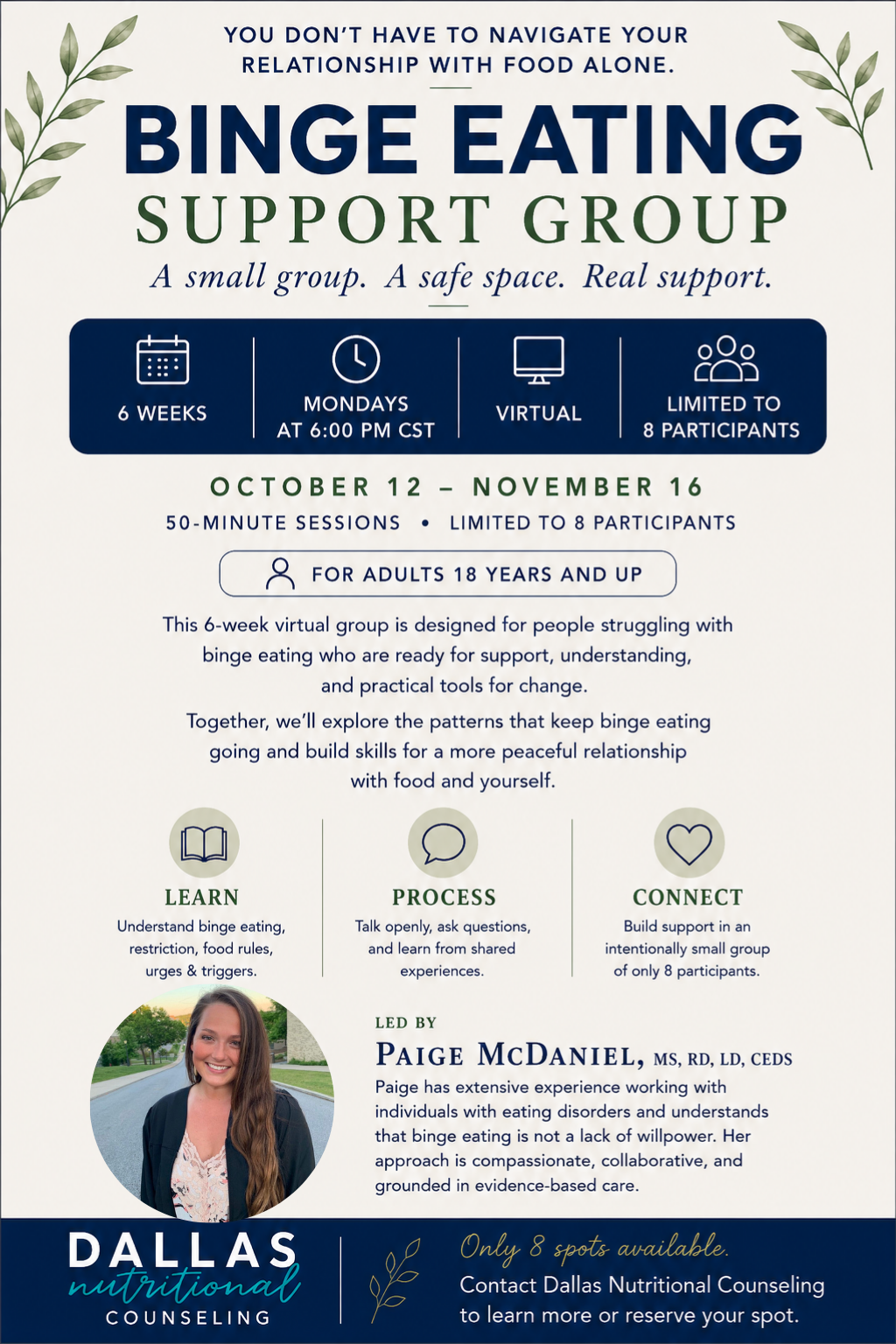
Binge Eating Support Group - Beginning October 12th, Dallas Nutritional Counseling, Paige McDaniel
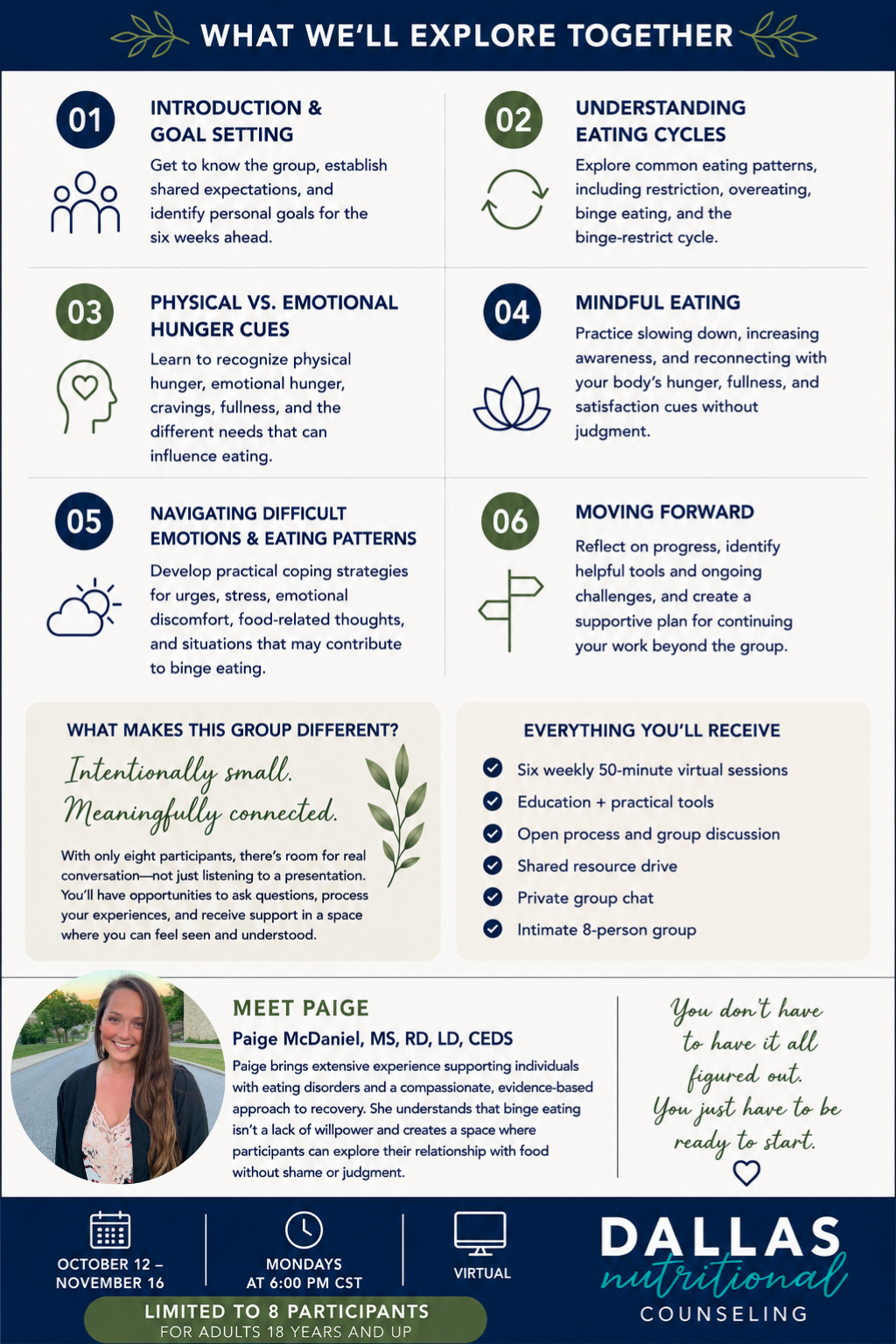
Binge Eating Support Group - Beginning October 12th, Dallas Nutritional Counseling, Paige McDaniel

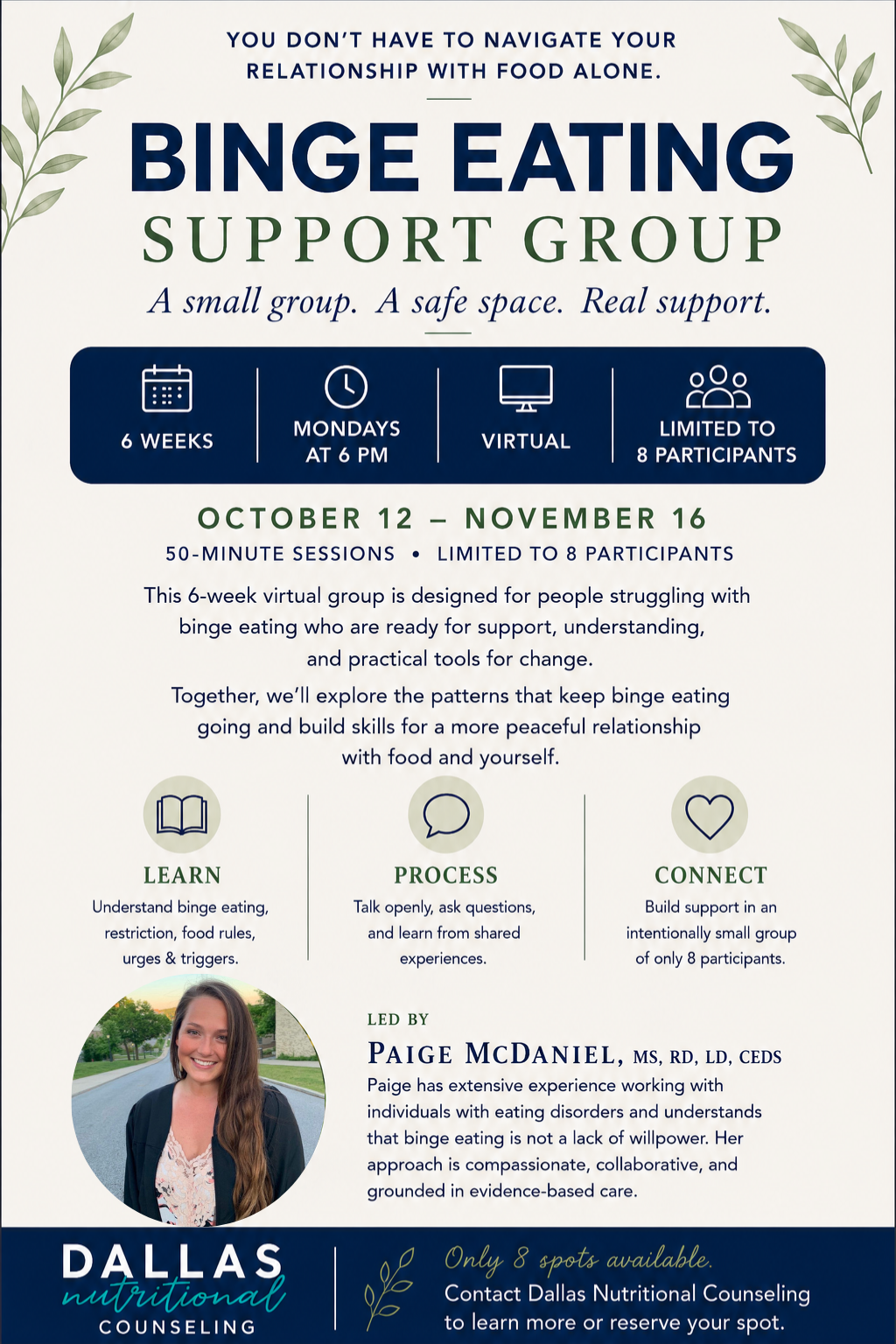
Why Willpower Isn’t the Answer to Binge Eating. 6-Week Virtual Group | Monday Evenings | 6:00 PM CST, October 12 – November 16, 50-minute sessions | Limited to 8 participants