Physical Hunger vs. Emotional Hunger: How Can You Tell the Difference?
“Am I actually hungry—or am I just eating because I’m emotional?”
It’s a question we hear frequently.
And while learning to recognize different types of hunger can be helpful, there’s an important point that often gets lost:
Eating for emotional reasons doesn’t automatically mean you’re doing something wrong.
Food serves many purposes. It provides nourishment, but it can also provide pleasure, comfort, connection, tradition, and enjoyment.
The goal isn’t to eliminate every instance of emotional eating. Instead, we can become more curious about what our bodies and emotions are communicating.
What Does Physical Hunger Feel Like?
Physical hunger is your body’s way of signaling that it needs energy.
It doesn’t feel exactly the same for everyone.
Some common signs can include:
A growling or empty stomach
Low energy
Difficulty concentrating
Irritability
Feeling shaky or lightheaded
Thinking more frequently about food
A gradual increase in desire to eat
One challenge is that people who have spent years dieting, restricting, ignoring hunger, or following external food rules may have difficulty identifying these signals.
Hunger cues aren’t always loud.
Sometimes reconnecting with them takes practice.
What Is Emotional Hunger?
Emotions can also create a desire to eat.
You may notice yourself reaching for food when you’re:
Stressed.
Bored.
Lonely.
Overwhelmed.
Angry.
Sad.
Exhausted.
Even happy or excited.
Emotional eating isn’t necessarily a problem. Having ice cream after a difficult day or celebrating with your favorite meal can be part of a completely normal relationship with food.
It becomes worth exploring when food begins to feel like your only coping strategy or when eating regularly leaves you feeling distressed or out of control.
Sometimes It’s Both
One reason the “physical or emotional?” question can be difficult is that hunger isn’t always one or the other.
Imagine you’ve been busy and haven’t eaten for six hours.
You’re physically hungry.
Then you get home after a stressful day.
Now you’re physically hungry and emotionally depleted.
Those experiences interact.
If you approach that moment believing you “shouldn’t” be hungry or shouldn’t eat emotionally, you may try to resist eating altogether.
That can intensify both needs.
Instead of trying to perfectly categorize hunger, it may be more helpful to ask:
What am I noticing right now?
When did I last eat?
What does my body need?
What am I feeling emotionally?
Would food help?
Is there anything else I need in addition to food?
Notice the phrase in addition to.
Sometimes you need dinner and rest.
A snack and someone to talk to.
Dessert and an opportunity to decompress.
These needs don’t have to compete.
What About Cravings?
Cravings are another normal part of eating.
You can be physically hungry without craving anything specific, and you can crave something without experiencing intense physical hunger.
Satisfaction matters.
You might eat a meal that technically provides enough energy but still find yourself searching through the kitchen afterward because the meal wasn’t satisfying.
Learning to consider hunger, fullness, preference, and satisfaction can help you develop a more flexible relationship with food.
Reconnecting With Your Body Takes Practice
If you’ve followed diets or external food rules for years, you may not immediately know what hunger and fullness feel like.
That’s okay.
You don’t need to become perfectly intuitive overnight.
Start with curiosity rather than judgment.
Instead of asking:
“Was I good or bad today?”
Try asking:
“What did I notice?”
That small shift can provide much more useful information.
Explore This With Support
Physical and emotional hunger is one of the topics we’ll explore in Dallas Nutritional Counseling’s upcoming 6-week Virtual Binge Eating Support Group.
Led by Paige McDaniel, MS, RD, LD, CEDS, the group combines education and practical tools with open discussion and group support.
October 12 – November 16 | Mondays at 6 PM | Virtual
$500 for all 6 sessions, $450 with early bird registration (use code EARLYBIRD at check out before October 25th)
The group is limited to 8 participants to allow for meaningful conversation and connection.
Contact Dallas Nutritional Counseling to learn more.
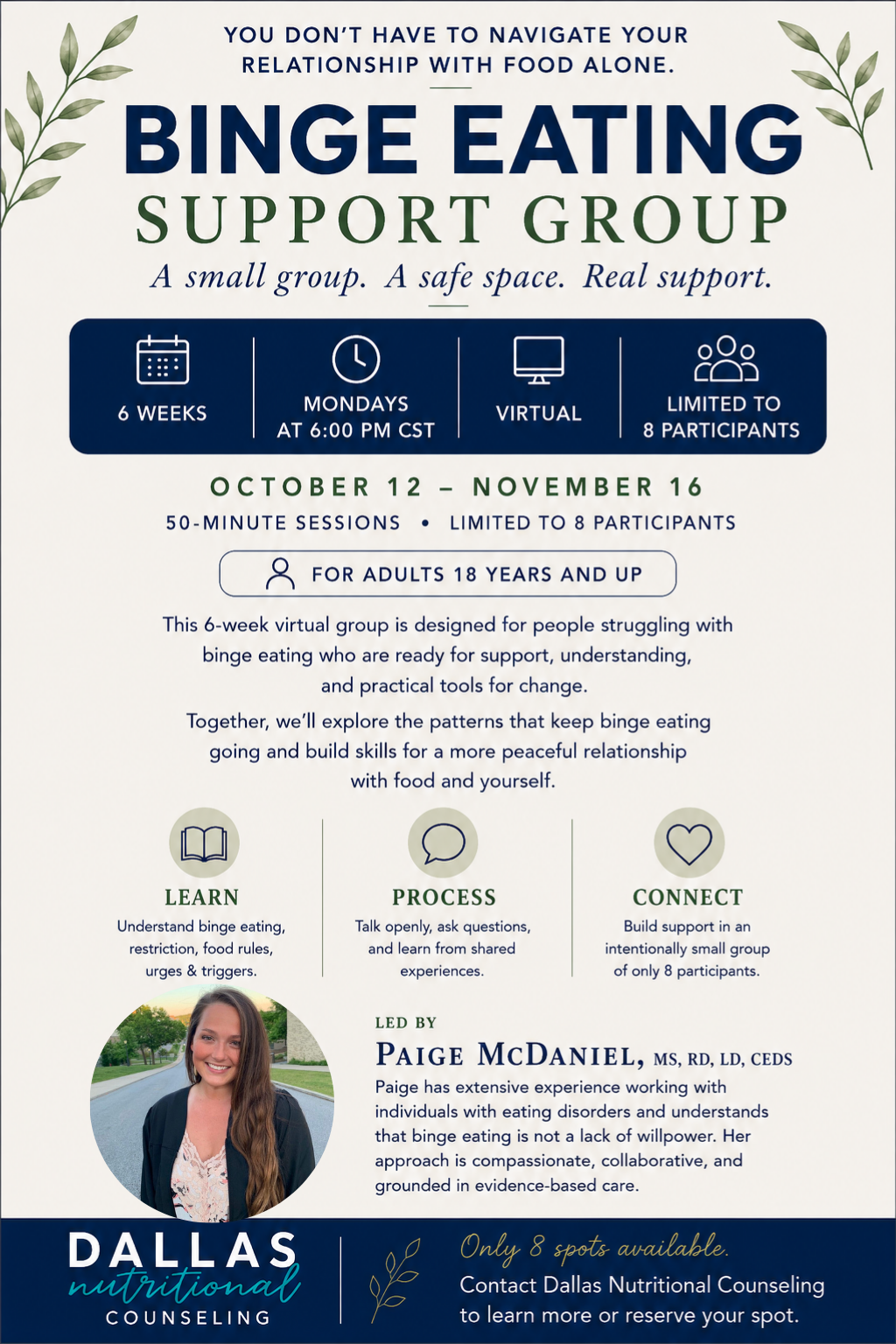
Binge Eating Support Group - Beginning October 12th, Dallas Nutritional Counseling, Paige McDaniel
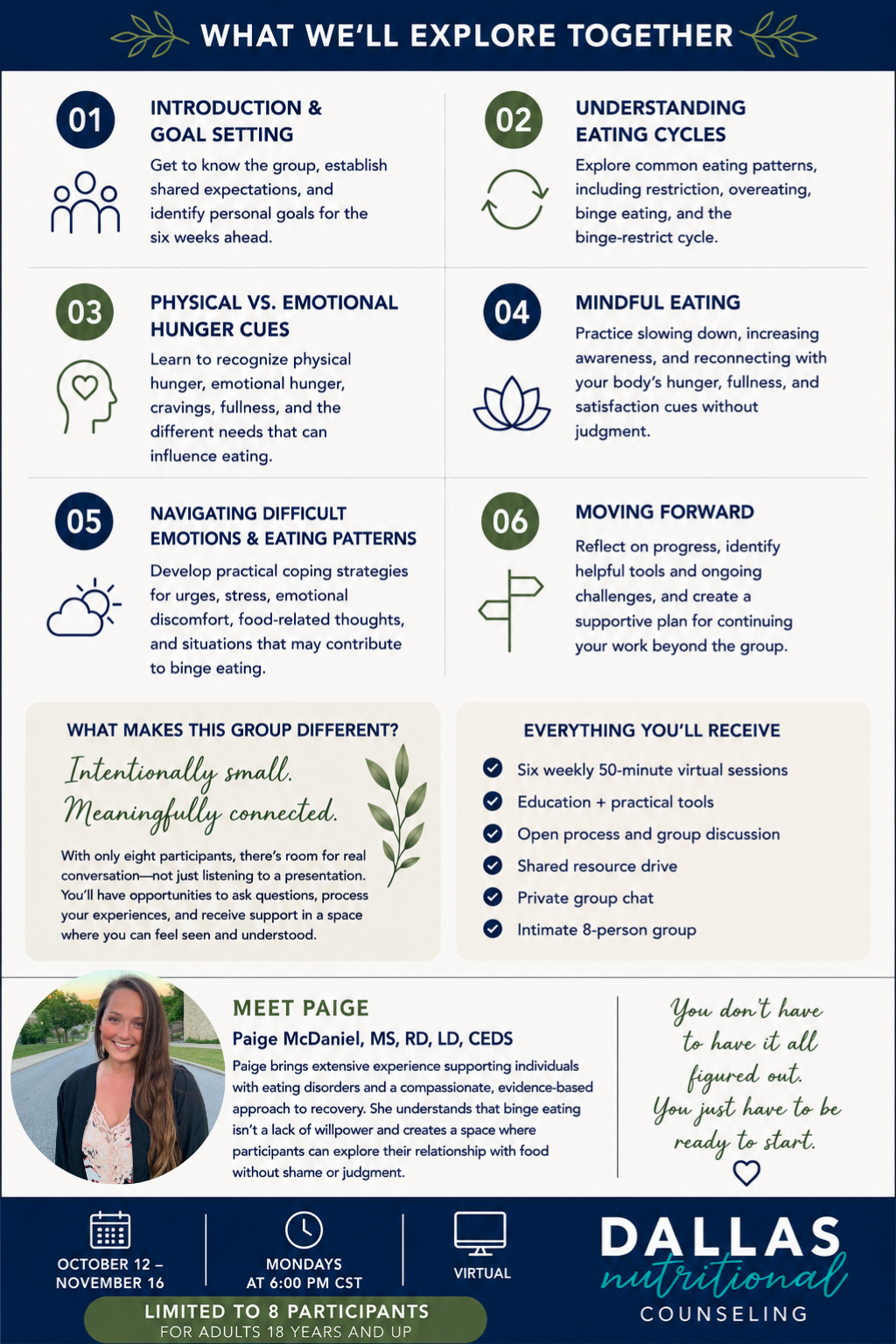
Binge Eating Support Group - Beginning October 12th, Dallas Nutritional Counseling, Paige McDaniel


Physical Hunger vs. Emotional Hunger: How Can You Tell the Difference?Binge Eating Support Group - For when you’re tired of feeling out of control around food—and tired of trying to fix it on your own. 6-Week Virtual Group | Monday Evenings | 6:00 PM CST, October 12 – November 16, 50-minute sessions | Limited to 8 participants