Why Do I Keep Binge Eating? Understanding the Binge-Restrict Cycle
If you’ve ever found yourself thinking, Why do I keep doing this?, you’re not alone.
Binge eating can feel confusing—especially when you genuinely intend to eat differently. You may wake up determined to “be good,” follow your plan all day, and then find yourself feeling out of control around food later.
Afterward, you might feel guilty, frustrated, or embarrassed and decide that tomorrow will be different.
So you restrict again.
And the cycle continues.
One of the first steps toward changing binge eating is understanding that the binge itself may only be one part of the problem.
What Is the Binge-Restrict Cycle?
The binge-restrict cycle can look different from person to person, but a common pattern is:
Restriction → increased hunger or food preoccupation → binge eating → guilt or shame → renewed restriction
Restriction doesn’t always mean dramatically limiting how much you eat.
It can also look like:
Skipping meals to “make up” for eating
Avoiding certain foods because you consider them “bad”
Trying to eat as little as possible during the day
Saving calories for later
Cutting out carbohydrates or other food groups
Starting a new diet after a binge
Exercising to compensate for what you’ve eaten
These behaviors can feel like a logical response to binge eating. If eating felt out of control yesterday, tightening the rules today may seem like the solution.
Unfortunately, restriction can sometimes set the stage for another binge.
Your Body Responds to Restriction
Your body is designed to protect you from inadequate nourishment.
When you aren’t eating enough—or aren’t eating consistently—hunger can become more intense. You may also notice yourself thinking about food more often.
Foods you’ve labeled “off limits” can become particularly compelling.
This isn’t necessarily evidence that you’re addicted to those foods or that you lack self-control. Your body and brain may simply be responding to deprivation.
Eventually, hunger, food preoccupation, emotions, stress, or simply being around a forbidden food can become overwhelming.
A binge happens.
Then comes the guilt.
And often the response is: I need to get back under control.
So restriction begins again.
Food Rules Can Keep the Cycle Going
Restriction isn’t only physical. It can also be psychological.
You might technically allow yourself to eat pizza while simultaneously thinking:
I shouldn’t be eating this.
I’ve already had too much.
This is so unhealthy.
I’ll start over tomorrow.
Those rules can create an all-or-nothing relationship with food.
If you’ve already “broken the rule,” it can begin to feel as though the rest of the day doesn’t matter.
That familiar thought appears:
I already messed up. I might as well keep eating.
Understanding and challenging rigid food rules can therefore be an important part of reducing binge eating.
What About Emotions?
Not every binge begins with physical hunger.
Stress, loneliness, boredom, anger, anxiety, exhaustion, sadness, and even excitement can influence eating.
Food can be comforting. It can distract us. It can temporarily numb uncomfortable feelings. It can also be pleasurable—and pleasure from food is not inherently a problem.
Instead of simply asking, “How do I stop emotional eating?”, it can be more useful to ask:
“What is happening when I feel the urge to binge, and what might I need in that moment?”
Sometimes the answer is food.
Sometimes it’s rest, connection, comfort, boundaries, distraction, or another coping strategy.
And sometimes it’s a combination.
Breaking the Cycle Isn’t About Becoming More Restrictive
This can feel counterintuitive.
If binge eating feels like “too much food,” the instinct is often to respond with less food and more rules.
But meaningful change may involve learning to:
Eat consistently.
Recognize hunger and fullness.
Identify rigid food rules.
Allow previously forbidden foods.
Notice emotional triggers.
Develop additional coping skills.
Respond to a binge with curiosity rather than punishment.
The goal isn’t perfect eating. It’s gradually creating a relationship with food that doesn’t require constantly swinging between control and feeling out of control.
Want Support Breaking the Cycle?
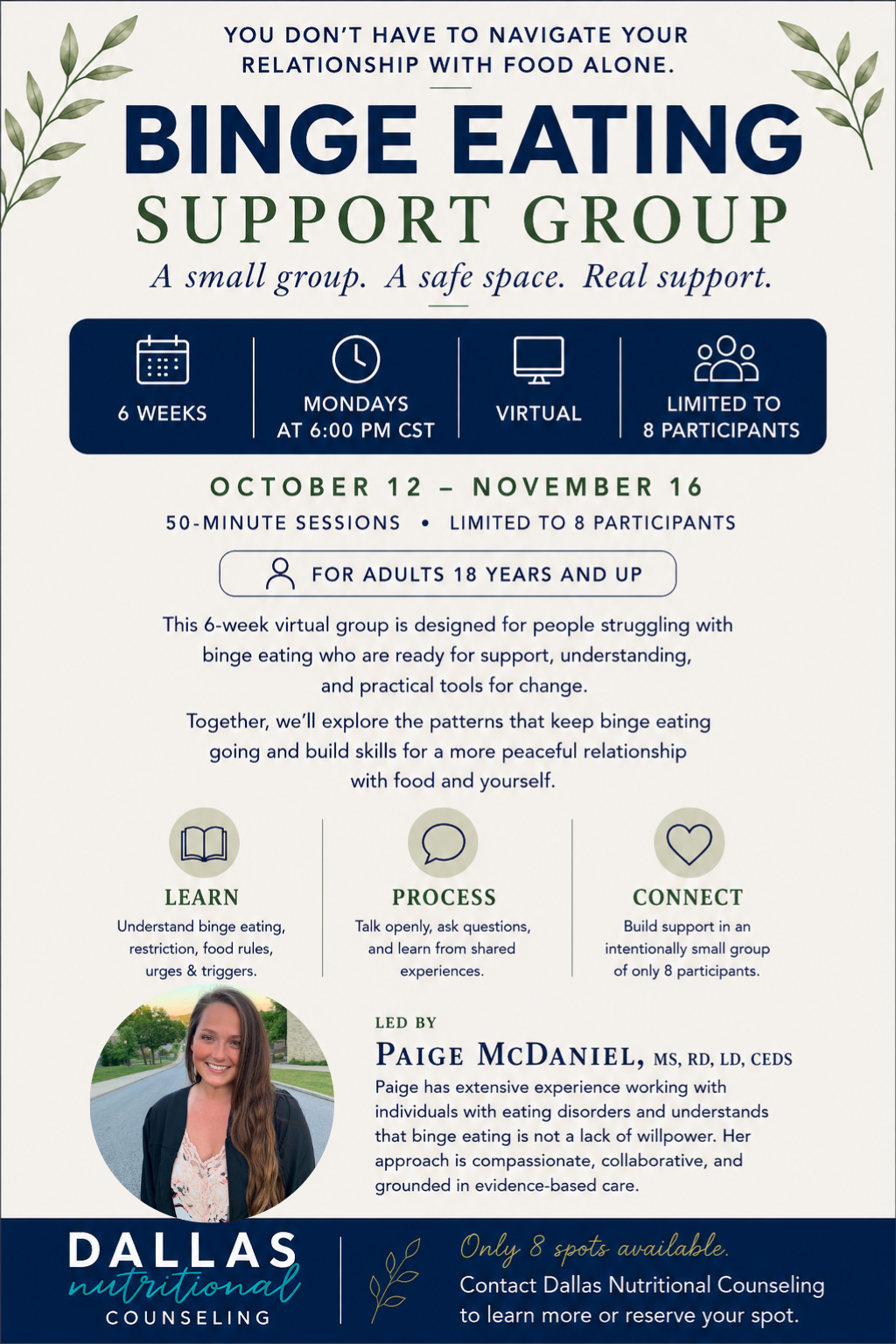
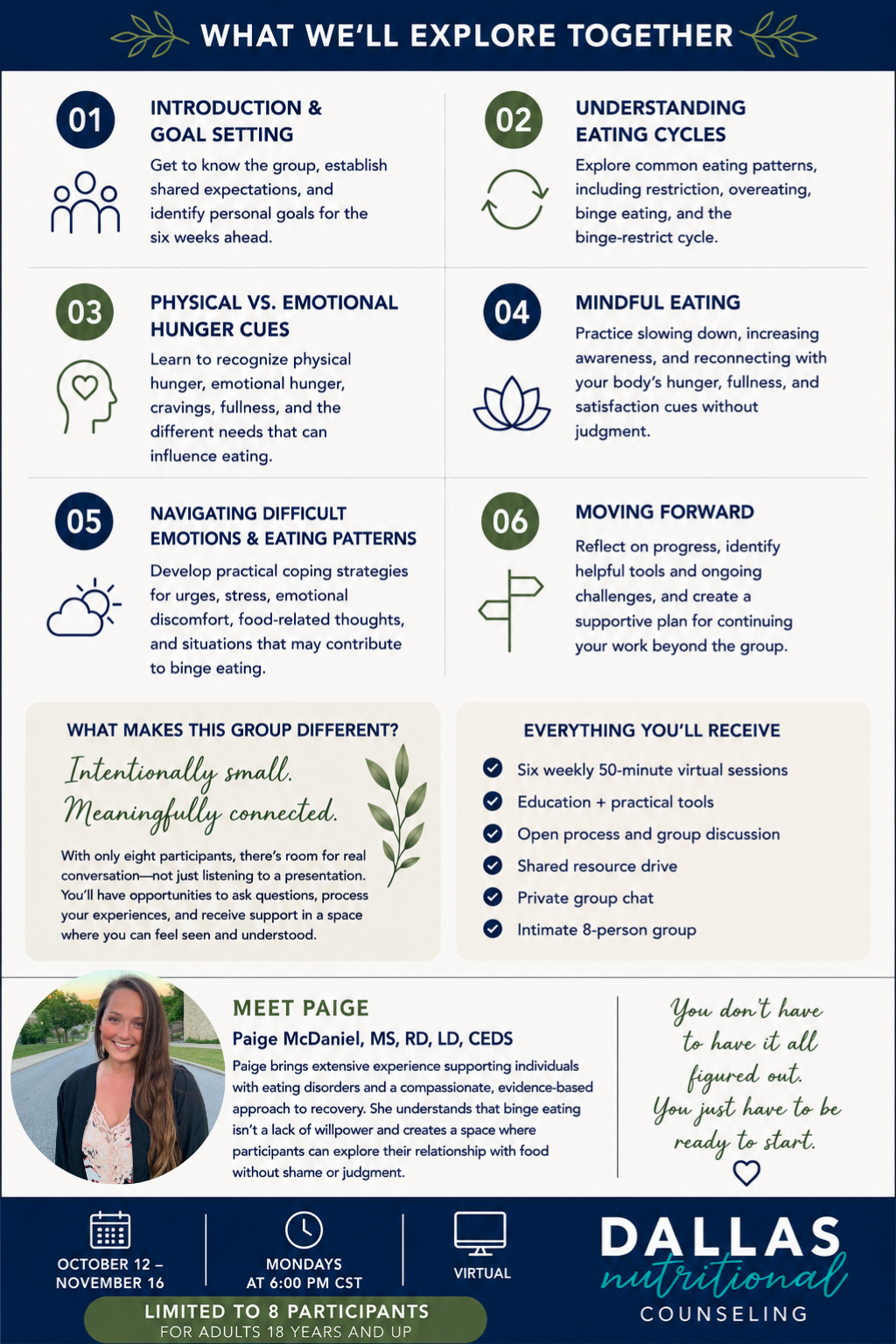
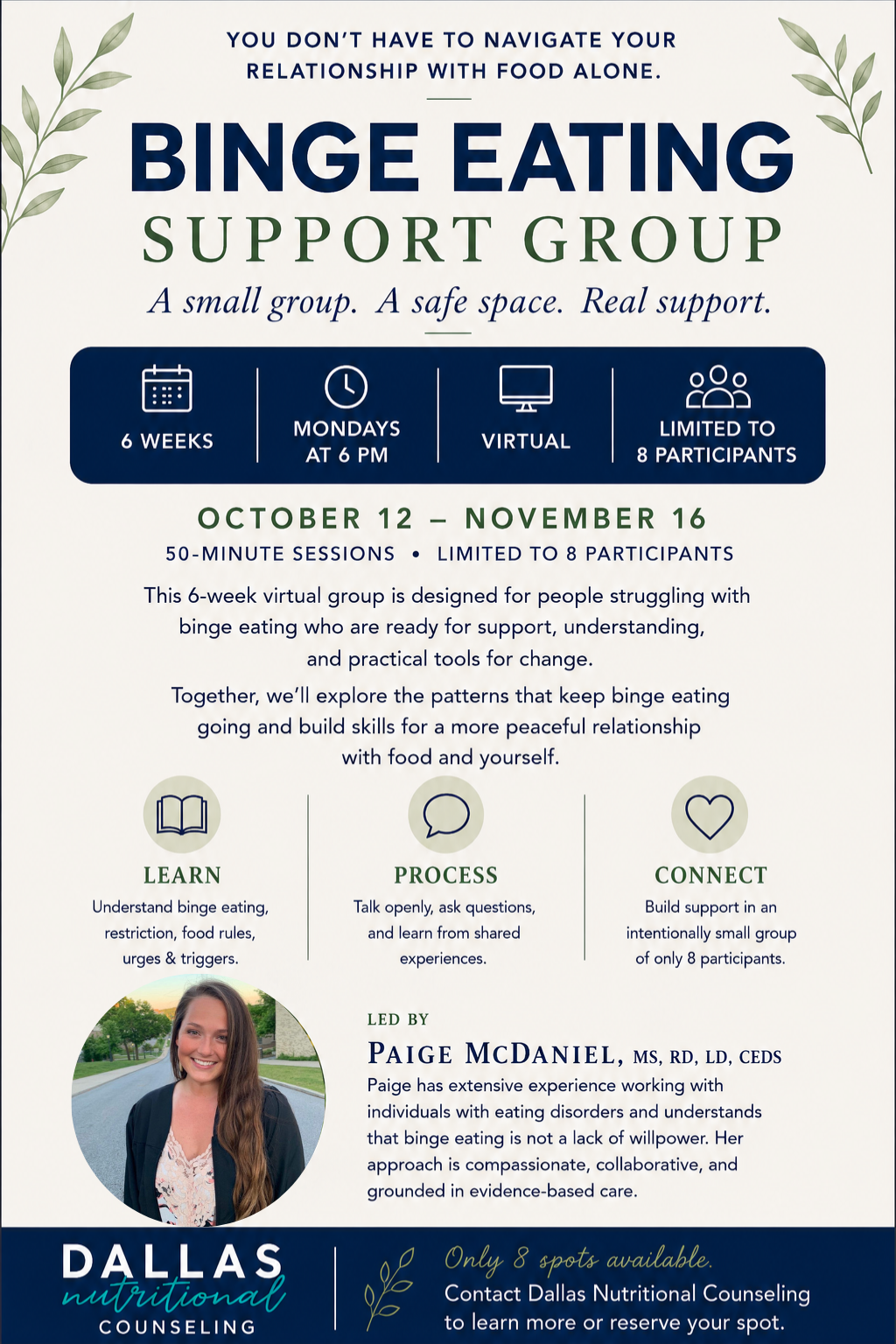
Dallas Nutritional Counseling is offering a 6-week Virtual Binge Eating Support Group led by Paige McDaniel, MS, RD, LD, CEDS.
Together, we’ll explore the patterns that contribute to binge eating while developing practical tools in a small, supportive environment.
October 12 – November 16 | Mondays at 6 PM | Virtual | 50 minutes
$500 for all 6 sessions, $450 with early bird registration (use code EARLYBIRD at check out before October 25th)
Enrollment is intentionally limited to 8 participants.
Contact Dallas Nutritional Counseling to learn more or reserve your spot.
Binge Eating Support Group - Beginning October 12th, Dallas Nutritional Counseling, Paige McDaniel
Binge Eating Support Group - Beginning October 12th, Dallas Nutritional Counseling, Paige McDaniel

Advance your eating disorder treatment skills with on-demand professional trainings in ARFID, co-occurring diagnoses, and severe and enduring eating disorders.