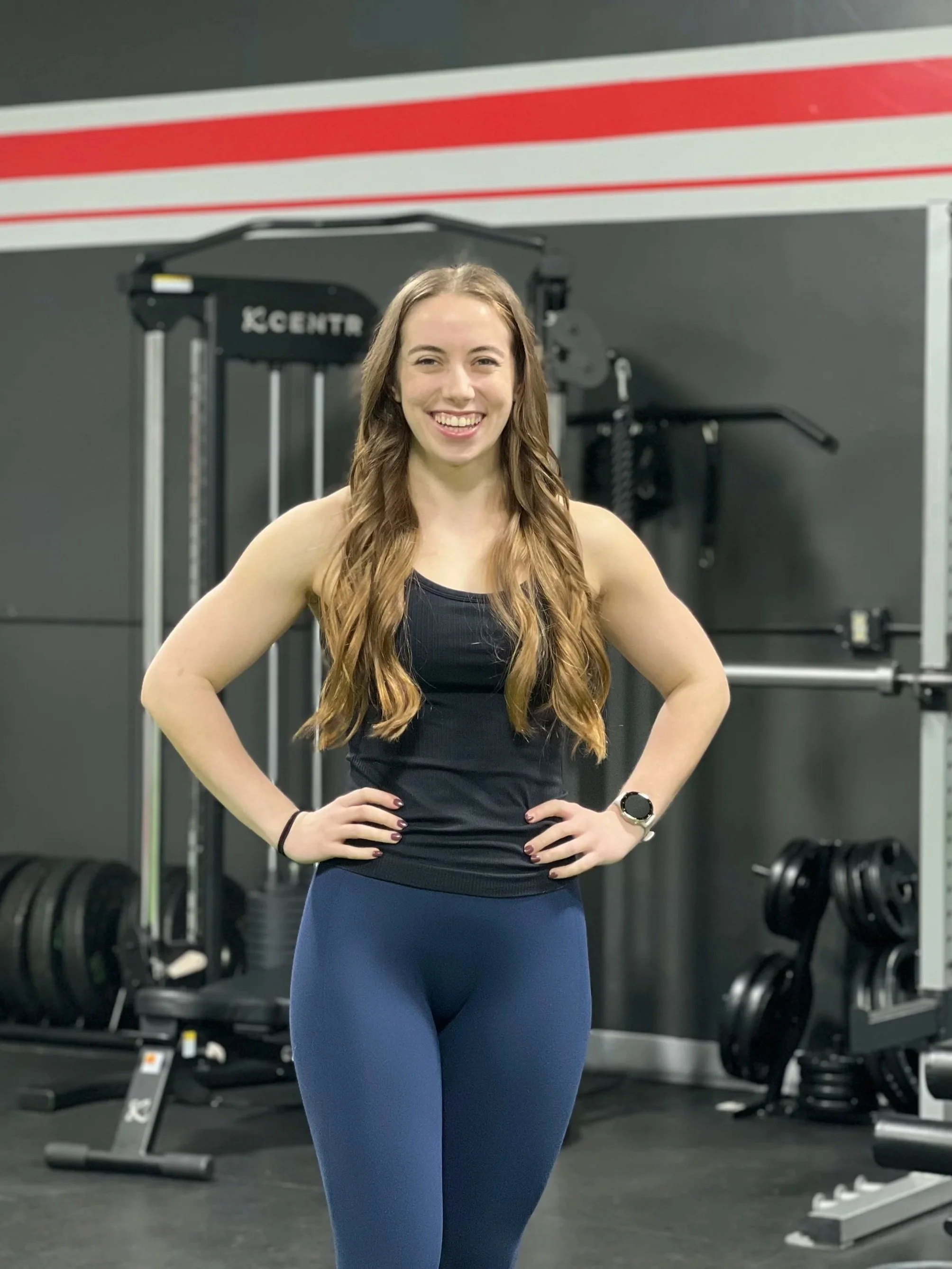
Caitlin Gill, CPT
Certified Personal Trainer | Adaptive Personal Trainer | Intuitive Movement & Strength
Caitlin Gill is a Certified Personal Trainer and Certified Adaptive Personal Trainer who provides individualized, client-centered personal training for adolescents and adults.
Whether you want to get stronger, feel more confident using weights, improve mobility or endurance, return to exercise after time away, support your health, or simply find a way to move that you actually enjoy, Caitlin starts with your goals, not hers.
She doesn't believe a personal trainer's job is to decide what your body should look like or what you should want from exercise. Instead, she takes time to understand what matters to you, your previous experiences with movement, what feels realistic in your life, and what you would genuinely like to be able to do.
From there, Caitlin builds training around the individual rather than forcing the individual into a predetermined fitness program.
Your Goals Are the Goals
Personal training can sometimes come with an unspoken agenda: lose weight, get smaller, burn more calories, work harder, or chase someone else's definition of being “fit.” That's not how Caitlin works.
Your goals might be to lift heavier weights. Have more energy. Improve your balance. Feel steadier on your feet. Walk farther without getting tired. Learn how to use gym equipment. Keep up with your kids. Return to an activity you used to enjoy. Feel stronger in everyday life. Develop a consistent movement routine. Or simply figure out what kinds of exercise you actually like.
Caitlin helps clients identify goals that are meaningful to them and builds sessions around making progress toward those goals. She also emphasizes non-scale victories as meaningful measures of progress.
Maybe you carried all the groceries inside in one trip. Increased the weight you can comfortably lift. Took the stairs without thinking about it. Noticed better balance. Felt less intimidated walking into a gym. Recovered more easily after a workout. Tried an activity you previously avoided. Or realized that exercise no longer dictates the rest of your day. Those changes matter. Caitlin believes fitness can improve someone's life without requiring them to make changing their body size the goal.
Personal Training That Meets You Where You Are
You don't have to already be “in shape” to start personal training. You also don't need a weight-loss goal, an athletic background, or a desire to spend five days a week in the gym. With a background in Exercise Science and Health Psychology, Caitlin works with people across a wide range of ages, abilities, fitness levels, and experiences with exercise.
Some clients come to her because they simply want a knowledgeable trainer who can help them become stronger and more confident. Others have physical or medical considerations that require more individualized programming. Some are rebuilding their relationship with exercise after years of dieting or compulsive movement. Others are returning to movement during eating disorder recovery.
Whatever brings someone to personal training, the starting point is the same: What do you want movement to help you do?
Personal Training for Hypermobility & Ehlers-Danlos Syndrome
For someone with hypermobility, more flexibility isn't necessarily the goal. Exercise may need to account for joint instability, differences in proprioception and body awareness, previous injuries, pain, fatigue, and movements that don't feel the same in a hypermobile body as they do for someone without hypermobility.
Caitlin is familiar with hypermobility disorders, including Ehlers-Danlos syndrome (EDS), and understands the importance of adapting exercise rather than simply pushing through symptoms or applying a standard fitness program.
Her adaptive training background allows her to modify exercises around the individual in front of her, with an emphasis on building strength, stability, confidence, and sustainable movement patterns.
For clients who are also working with physicians, physical therapists, or other healthcare professionals, Caitlin can incorporate their recommendations and limitations into the training environment while remaining within the scope of personal training.
The goal isn't to prove how much your body can tolerate. It's to build strength and movement capacity while respecting what your body is communicating.
Movement During Eating Disorder Recovery
Movement can become complicated when an eating disorder is involved.
Exercise may have become rigid, compulsive, or connected to food, weight, body image, or a need to follow certain rules. Some clients struggle to take rest days or adjust a workout even when they're injured, exhausted, or sick. Others have been asked to stop exercising during treatment and feel anxious or uncertain about what returning to movement is supposed to look like.
And for some people, the goal isn't to “get back” to the relationship with exercise they had before treatment. It's to build a different one.
Caitlin provides an eating-disorder-informed training environment where movement doesn't have to be about calorie burn, earning food, changing body size, or doing more.
When appropriate, she works alongside the registered dietitians at Dallas Nutritional Counseling and other members of a client's treatment team to support a thoughtful return to movement.
Depending on the individual and where they are in recovery, sessions may focus on rebuilding strength after a period of reduced activity, reconnecting with physical cues, learning to adjust movement based on how the body feels, practicing flexibility around exercise, incorporating rest, exploring new forms of movement, or identifying goals that have nothing to do with appearance.
Caitlin also understands that returning to movement isn't always linear.
There may be times when the treatment team recommends modifying, reducing, or temporarily pausing certain forms of exercise. Caitlin can work within those recommendations rather than treating them as obstacles to a fitness program.
The goal is not simply to get someone exercising again. It's to help movement become something that can coexist with recovery.
A Different Relationship With Exercise
You don't have to have an eating disorder for your relationship with exercise to feel complicated. Years of dieting and fitness messaging can teach people that exercise only “counts” when it's intense, that missing a workout means they've failed, or that the primary purpose of movement is to change their body. Caitlin helps clients question some of those assumptions.
Her approach incorporates principles of intuitive movement, body neutrality, and health psychology, creating space to explore reasons for movement beyond appearance or calorie expenditure.
Strength. Energy. Mobility. Confidence. Stress relief. Independence. Function. Enjoyment. Being able to participate more fully in everyday life. Those outcomes count, too.
Caitlin isn't interested in replacing one rigid set of exercise rules with another. She helps clients develop a more flexible approach to movement that can change with their bodies, schedules, health, interests, and lives.
Adaptive Training That Starts With the Person
Caitlin's approach to personal training is grounded in the belief that fitness is not one-size-fits-all.
Medical history, physical ability, previous injuries, mental health, relationship with exercise, age, goals, and life experiences can all influence what an appropriate movement program looks like.
As a Certified Adaptive Personal Trainer and Adaptive Group Fitness Instructor, Caitlin has additional training in modifying exercise for people whose needs may not be adequately served by conventional fitness programming.
She began her personal training career working with older adults focused on improving strength, function, and quality of life. She later expanded her work to children, adolescents, and adults with a wide range of fitness goals and health considerations.
That experience taught her not to begin with assumptions about what someone's body should be able to do. She begins with the person.
Working With Caitlin
Caitlin brings curiosity, flexibility, and compassion to personal training. She recognizes that two people can perform the same exercise and experience it very differently. Rather than forcing someone's body to conform to the exercise, she's comfortable changing the exercise to better fit the person.
Sessions are collaborative. Caitlin wants to know what feels good, what doesn't, what you're noticing in your body, what you're nervous about, and what you'd actually like movement to help you accomplish.
She'll challenge you when challenge supports your goals, but she isn't interested in pushing for the sake of pushing.
That makes Caitlin a particularly good fit for people who haven't felt comfortable in traditional fitness spaces, clients who need adaptations because of a medical or physical condition, and those who want to become stronger without returning to an unhealthy or rigid relationship with exercise.
You don't have to prove anything to be there. The goal is not to become better at ignoring your body. It's to become stronger and more confident while learning how to work with it.
Areas of Expertise
Individualized personal training
Strength and resistance training
Hypermobility and Ehlers-Danlos syndrome
Adaptive personal training
Strength and stability for hypermobile clients
Eating disorder recovery and return to movement
Compulsive and rigid exercise patterns
Intuitive movement
Body-neutral and weight-inclusive fitness
Non-scale fitness goals
Adolescents and adults
Beginner and gym-anxious clients
Functional fitness
Senior fitness
Exercise adaptations for medical conditions
Building confidence with movement
Lifestyle behavior change
Collaboration with dietitians, physical therapists, and healthcare providers
Education & Certifications
Caitlin earned her Bachelor's Degree in Kinesiology with a focus in Exercise Science and a minor in Health Psychology from Texas Woman's University.
She is a Certified Personal Trainer through the National Academy of Sports Medicine (NASM) as well as a Certified Adaptive Personal Trainer and Adaptive Group Fitness Instructor.
Her combination of exercise science, health psychology, and adaptive training informs an approach to fitness that considers both physical and psychological well-being.